Why Indian Travel Hurts Your Neck
Indians are among the world’s most experienced long-distance travellers. A Mumbai-to-Delhi train journey is 16–23 hours. A Delhi-to-Manali road trip is 14–16 hours. A Hyderabad-to-Kochi drive covers 700+ km. These are not short-haul experiences — they’re endurance events for your musculoskeletal system.
The problem isn’t just duration. It’s the combination of vibration, unpredictable movement, limited position options, ambient noise preventing deep sleep, and seat designs that offer zero genuine neck support. The result: you arrive stiff, sore, and exhausted — even if you technically “slept” during the journey.
Duration of India’s busiest long-distance train routes — more than twice a transatlantic flight, with far worse sleep conditions
Sleeping with your head dropped forward at 45° (the classic “nodding off” slump) puts approximately 22 kg of equivalent load on your cervical spine. Do this for 8 hours on a night train and you’re not arriving at your destination rested — you’re arriving in early-stage neck strain.
The U-Shaped Pillow Problem
The inflatable U-shaped neck pillow — that iconic ring you see at airports — is one of the most popular travel accessories in India. It’s also, for most use cases, poorly designed for Indian travel conditions.
U-shaped pillows were designed for aeroplane seats, which recline to 30–45°. On this angle, a wrap-around neck pillow stabilises the head effectively. But on Indian trains, the berths are either nearly flat (lying down) or bolt upright (sitting). Neither position works well with a U-shaped design.
On a sitting position without headrest support (like a bus or car seat), a U-shaped pillow holds your head in a slightly forward position — exactly the posture that strains the cervical spine. You feel supported, but the underlying alignment is poor.
Worse, inflatable versions provide inconsistent pressure. They’re either over-inflated (hard and pressing against your neck) or under-inflated (collapsed and useless). The memory foam U-pillows fare better but are bulky to pack and often too firm for the Indian climate.
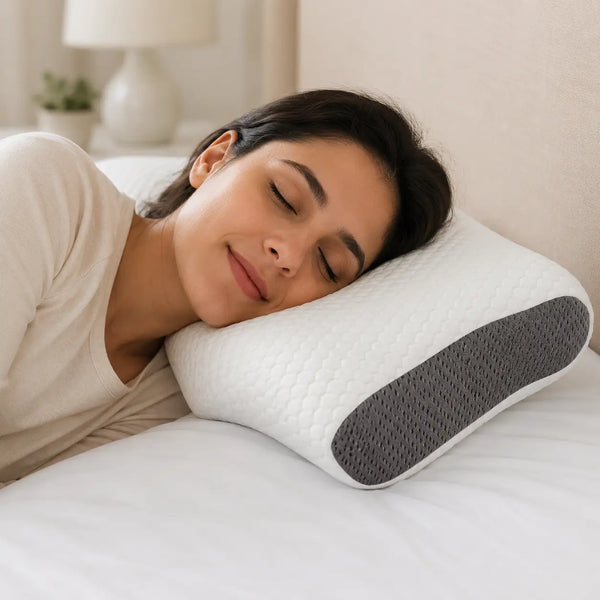
A compact, flat orthopedic pillow used as a head support against the seat back or window often outperforms a U-shaped travel pillow — especially on overnight train berths where you’re lying semi-flat. The key is loft (height) matching your shoulder-to-head distance in your sleep position.
Different Travel, Different Needs
Indian Railways (Overnight)
Berths are 6 inches narrower than standard beds. You need a pillow with good loft (8–10 cm) and firm support to prevent head tilt on the narrow surface. A flat travel pillow works better than a U-shape here.
Long-Distance Bus (Day/Night)
Semi-sleeper and sleeper buses vary wildly in recline angle. A U-shaped pillow can work on fully reclined seats; a flat pillow against the seat back is better for semi-reclining positions.
Road Trip (Car)
Front passengers can adjust headrest; back seat passengers often can’t. A medium-firm compact pillow placed between the head and headrest (or window) reduces the uncontrolled “nodding” during dozing.
Domestic Flights
Indian domestic flights are typically 1–3 hours — too short for deep sleep. A U-shaped pillow works adequately here. A packable flat pillow against the window is more comfortable if you’re a window-seat sleeper.
What to Actually Look For in a Travel Pillow
1. Loft (Height)
This is the most important factor. The pillow needs to be thick enough to keep your head aligned with your spine in your specific sleeping position. For side sleeping on a train berth, you need roughly the same loft as your bedside pillow. For upright sleeping in a seat, you need less — about 6–8 cm.
2. Firmness
Travel pillows need to be firmer than home pillows. Movement and vibration during travel cause a soft pillow to compress further, lowering effective loft mid-journey. A pillow that feels “too firm” at home often becomes “just right” after a few hours on a moving train.
3. Packability
A pillow you won’t pack isn’t a travel pillow. Compressible memory foam that fits inside its own pouch or straps to a backpack is far more practical than a full-size pillow, however comfortable the latter might be.
4. Washability
Train berths in India accumulate dust, and shared pillows are hygienically questionable. Your travel pillow cover should be fully removable and machine washable. A spare cover is worth the extra ₹100–₹200 of bulk.
5. Temperature Performance
Overnight trains and buses in India are either aggressively air-conditioned (AC coaches) or warm and stuffy (sleeper class). A pillow with a breathable cover performs better in both: cooler in warm conditions, and comfortable even in AC.
Travel Pillow Types Compared for Indian Travel
| Type | Best Use Case | For Indian Trains | For Road Trips | Packability |
|---|---|---|---|---|
| Inflatable U-shape | Short flights (1–3h) | Poor | Poor | Excellent (deflated) |
| Memory Foam U-shape | Long flights | Poor | Adequate (reclining seat) | Moderate (bulky) |
| Compact flat pillow | Overnight trains, berths | Best | Best | Good (compressed) |
| Microbead pillow | Car trips, short journeys | Adequate | Good | Good |
| Rolled clothing/towel | Emergency use only | Poor | Poor | Excellent |
The underrated option: Many seasoned Indian travellers pack a compact version of their regular orthopedic pillow. It adds 500g of bag weight but provides genuinely restful sleep on overnight journeys — a worthwhile trade for 12-hour trains to Rajasthan or Kerala.
Indian Railways Sleep Tips That Actually Work
Side Lower Berth Tip
Lower berths are preferred for sleep because you control them fully after 10 PM. Bring your own pillow — Indian Railways provides one but the quality and hygiene are variable. Place the pillow at the window end to avoid the corridor noise. Use a light dupatta or travel blanket to cover your face from the berth lighting.
Side Upper Berth Tip
Upper berths have more privacy but less ventilation. They also vibrate more due to their position. A firmer pillow handles vibration better. Don’t try to sleep on your back on an upper berth with no side support — you risk rolling. Side sleeping with the pillow angled toward the wall is more secure.
AC vs Sleeper Class Sleep
3A and 2A coaches are significantly cooler and quieter than sleeper class. If you’re a light sleeper, the extra cost is often worth it purely for sleep quality. The provided blankets in AC coaches, combined with a proper pillow, can approximate reasonable sleeping conditions on long journeys.
The Neck-First Rule for Car Trips
On road trips, the front passenger often gets the least restful sleep because they feel compelled to stay semi-alert. If you must sleep in a car, sit in the back, use your pillow against the window-side (not the door-latch side), and use a light neck pillow or rolled scarf to prevent forward head drop at road vibrations.
What Indian Travellers Say
“I travel Rajdhani to Delhi every month. Tried three different U-shaped pillows over the years — all rubbish. Switched to a compact flat pillow last year. First time in years I’ve arrived in Delhi not needing an hour to recover my neck. It’s that simple.”
“We did the Leh-Manali highway drive last August. 14 hours in a Bolero, mostly mountain roads. Brought the Cosymor pillow for the overnight stay and ended up using it in the car for the entire drive. My neck was fine; my husband (who used nothing) was stiff for two days.”
“I was sceptical about packing a ‘real’ pillow for travel. But after a 24-hour journey to Kolkata on the Coromandel Express where I used the Cosymor rolled up in my bag, I don’t travel without it now. It’s slightly bulky but worth every cm of backpack space.”
For overnight Indian Railways journeys (the most common long-distance travel scenario), a compact orthopedic flat pillow consistently outperforms U-shaped travel pillows. The flat pillow provides proper loft on berths, supports the neck in side sleeping, and doubles as a lumbar support on sitting journeys.
U-shaped pillows work adequately for flights and fully reclined bus seats. But for the 12–24 hour overnight train journeys that define Indian long-distance travel, they’re the wrong tool.
If you regularly travel by train or car across India, investing in a single good-quality compact pillow that you carry consistently will improve every journey significantly. The neck pain you’ve been normalising as “just part of travel” is not inevitable — it’s the product of the wrong pillow for your travel context.