The Memory Foam vs Latex Debate
Walk into any mattress or pillow store in India and you’ll hear two names: memory foam and latex. Both are marketed as “orthopaedic,” both come with bold claims, and both sit at very different price points. The question is: which one actually works better for the way Indians sleep, in the heat we live in, at a price that makes sense?
This guide cuts through the noise. We’ve tested both materials across different seasons, sleep positions, and body types — and spoken to sleepers from Mumbai, Delhi, Bengaluru, and Chennai to understand how these pillows perform in real Indian homes.
“I bought a latex pillow thinking it was better than foam, but by summer it felt just as hot — and cost me three times more. I wish I’d known what to actually look for.”
The truth: both memory foam and latex can be excellent — or terrible — depending on the specific product and how it’s designed. But some differences are material-level and unavoidable. Let’s go through each one.
Heat Retention in the Indian Climate
This is the big one for India. With temperatures regularly crossing 35–40°C in summer and high humidity in coastal cities, a pillow that traps heat is genuinely uncomfortable — not a minor inconvenience.
Memory Foam
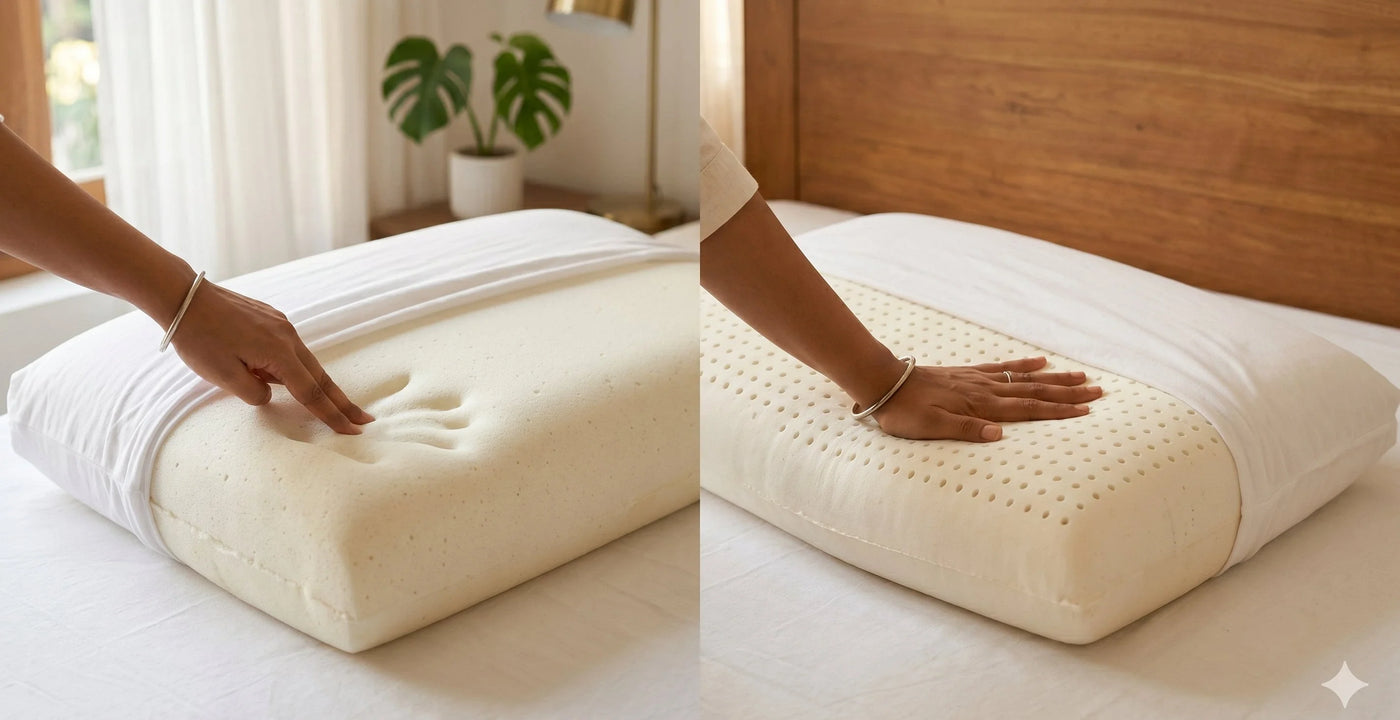
Traditional memory foam is a closed-cell material. This means air doesn’t flow through it easily, and it tends to absorb and retain body heat. In Indian summers, this can make a standard memory foam pillow feel warm within 20–30 minutes of contact. Modern open-cell memory foam and gel-infused variants address this — but the base material is inherently less breathable than latex.
That said, the pillow cover plays a significant role. A memory foam pillow with a bamboo or moisture-wicking cotton cover will sleep considerably cooler than one with a standard polyester case.
Latex
Natural latex has an open-cell structure with tiny pinholes throughout the material (Talalay process latex especially). Air moves through these channels, allowing heat to dissipate more effectively. In direct comparison tests, natural latex pillows tend to sleep 2–4°C cooler than traditional memory foam under the same conditions.
However, synthetic latex (often sold in India as “latex”) behaves closer to memory foam in terms of heat retention. If you’re buying latex for breathability, verify it’s natural latex — ideally Dunlop or Talalay processed.
Cooler surface temperature of natural latex vs traditional memory foam in controlled testing
Indian climate verdict on heat: Natural latex wins. But open-cell or gel memory foam with a breathable cover is a close second — and significantly more affordable.
Spinal Support Comparison
Both materials offer good support — but in very different ways. The experience of sleeping on each is distinct enough that most people have a clear preference after the first few nights.
How Memory Foam Supports You
Memory foam is viscoelastic — it responds to heat and pressure by slowly conforming to your head and neck shape. This “cradling” effect distributes pressure evenly. For side sleepers and people with existing neck pain, this conforming support is often described as immediately relieving. The material absorbs movement, so you don’t feel your partner shifting.
The downside: memory foam can feel like it “sinks” too deeply if the density is low. Lower-density foams (below 40 kg/m³) don’t provide enough pushback, leading to insufficient neck support. High-density orthopedic foam — 50–60 kg/m³ — holds position without excessive sink.
How Latex Supports You
Latex is responsive. It pushes back against your weight rather than conforming to it, giving a “floating on top” sensation rather than the “sinking in” feel of memory foam. This makes it feel cooler psychologically as well as physically. Back sleepers often prefer latex because it maintains loft without needing to “mould” to the neck curve.
Latex doesn’t absorb motion as well as memory foam, so movement is more perceptible — a factor if you share a bed. Natural latex also has more consistent support throughout the pillow, while memory foam’s support changes based on temperature (stiffer in cold, softer in heat).
Memory foam support changes with room temperature. A pillow that feels perfect in winter air-conditioning (18°C) may feel noticeably softer in summer heat (30°C). Latex is far more temperature-stable in its support properties.
Cost & Durability: The Real Numbers
Price is a significant differentiator in the Indian market. Here’s what you can realistically expect:
Memory Foam Cost
A quality high-density orthopedic memory foam pillow in India ranges from ₹800 to ₹3,500. Budget options exist below ₹800, but the foam density is typically too low (under 35 kg/m³) to provide meaningful neck support — it’ll flatten out within 3–4 months. A well-made memory foam pillow at the ₹1,500–₹2,500 range should hold its shape for 3–5 years.
Latex Cost
Natural latex pillows start around ₹2,500 and typically run ₹4,000–₹8,000 for quality options. Synthetic latex (sometimes called “latex foam”) is cheaper at ₹1,500–₹3,000 but doesn’t offer the same breathability or durability. Good natural latex lasts 5–8 years before degrading significantly.
Less expensive: quality memory foam vs natural latex at equivalent support levels — while still lasting 3–5 years
Durability Reality Check
Memory foam loses density over time, especially in humid climates. Natural latex is more resistant to compression set and humidity damage. However, latex can degrade if exposed to UV light or ozone (common in Indian cities with high pollution). Store both away from direct sunlight, and use pillow protectors to extend life significantly.
Full Comparison Table
| Factor | Memory Foam | Natural Latex | Winner |
|---|---|---|---|
| Heat Retention | Higher (traps heat in summer) | Lower (open-cell structure) | Latex |
| Conforming Support | Excellent (moulds to neck shape) | Good (pushes back, less moulding) | Memory Foam |
| Temperature Stability | Poor (softer in heat, firmer in cold) | Excellent (consistent in all temps) | Latex |
| Motion Isolation | Excellent | Moderate | Memory Foam |
| Pressure Relief | Excellent (distributes load) | Good (responsive support) | Memory Foam |
| Durability | 3–5 years (quality foam) | 5–8 years (natural latex) | Latex |
| Price (India) | ₹800–₹3,500 | ₹2,500–₹8,000 | Memory Foam |
| Value for Money | Excellent | Good (if buying natural) | Memory Foam |
| Allergy Resistance | Good (hypoallergenic foam) | Good (natural latex) / Note: latex allergy exists | Tie |
| Washability | Cover washable; core should not be washed | Cover washable; core should not be washed | Tie |
| Indian Summer Performance | Adequate with breathable cover | Better natural airflow | Latex |
| Best Sleep Position | Side & stomach sleepers | Back & side sleepers | Depends |
Who Wins for Which Sleeper?
Choose Memory Foam If:
- You sleep on your side or stomach — the conforming pressure relief is especially beneficial
- You have existing neck or shoulder pain — memory foam’s pressure distribution helps more acutely
- You want the best support at the lowest price point
- You or your partner are light sleepers — motion isolation is superior
- You use AC at night — temperature-controlled environments minimise memory foam’s heat disadvantage
Choose Natural Latex If:
- You sleep in a hot, humid city (Mumbai, Chennai, Kochi) with limited AC use
- You are a back sleeper who wants responsive loft rather than conforming cradle
- You want a longer-lasting pillow and are willing to invest upfront
- You prefer a bouncy, “on top” feel over the “sinking in” sensation
- Note: avoid if you have a latex allergy
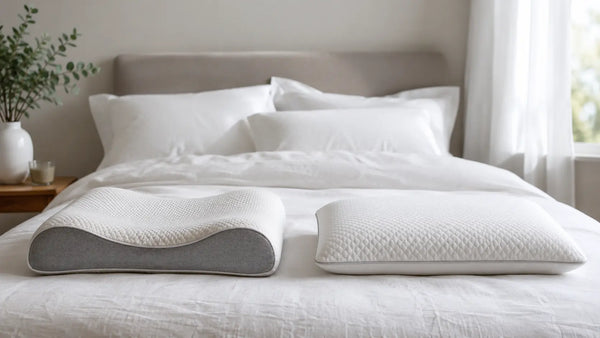
The Cosymor orthopedic pillow uses high-density orthopedic foam (55 kg/m³) with an open-cell structure and a bamboo-blended breathable cover — delivering the pressure relief of memory foam with significantly reduced heat retention. It targets the heat disadvantage of traditional memory foam without the cost premium of natural latex.
What Indian Customers Say
“I switched from a natural latex pillow to the Cosymor one after my latex started smelling odd in the monsoon. Honestly this is cooler and softer at the same time — and cost me half as much. No going back.”
“Living in Chennai with no central AC, heat was my biggest concern. The bamboo cover on this foam pillow genuinely makes a difference — slept through summer without waking up sweaty. I was sceptical about foam but converted now.”
“Used a latex pillow for 6 years before trying Cosymor. The memory foam cradling took adjustment — maybe 4–5 nights — but my neck pain has genuinely reduced. Still prefer latex’s bounciness but the support here is better for my side-sleeping.”
For most Indian buyers, high-density memory foam offers better value. At 40–60% less than natural latex, it delivers equivalent or superior spinal support — particularly for side and stomach sleepers. The heat disadvantage is real but addressable with a breathable cover.
Natural latex is worth the premium if you sleep without AC in a hot coastal climate, are a strict back sleeper, and plan to use the pillow for 6+ years. But for the majority of Indian sleep scenarios — AC at night, budget-consciousness, neck pain relief priority — quality memory foam wins the cost-benefit calculation.
The non-negotiable rule: never buy memory foam below 45 kg/m³ density. Low-density foam will flatten within months and provide neither comfort nor support. Look for 50–60 kg/m³ with a breathable cover, and you’ll get 90% of what natural latex offers at a fraction of the cost.